Binary Search
When should I use binary search?
You have already known that:
The problem is discrete and monotonic.
All candidate result values for the problem must be integers.
Suppose that we are solving a problem satisfying a property: the littler a variable
kbecomes, the more safely the condition can be reached. If akcan meet the requirement,k-1must can; If akcan’t meet the requirements,k+1must fail for the same condition checking. For this kind of problem, we usually maximize thekthat can meet some requirements (we refer to it as max problems in the following) or minimize thekthat can’t meet some requirements (we refer it as min problems in the following).Of course, you can negate the condition checking results to convert those problems in which larger
ksatisfies conditions better into the problem prototype here. Therefore, we only discuss the problems where akcan meet whilek+1fails here.
Given a variable
k, you can easily write a functioncheckto check ifkcan meet the requirements.A feasible lower bound
leftand an infeasible upper boundright(written as[left, right))Here, feasible
leftmeans: valueleftcan be returned as a final result for min problem, socheck(left)must returnTrue.Similarly, infeasible
rightmeans: valuerightcan’t be the result for min problem, that is, eithercheck(right)=Falseorrightis not in the legal data range for the problem.
Template
The template for min problem is:
def check(k) -> bool:
    # if conditions met, return True; Otherwise, return False

left, right = # [left,right)

while left < right:
    mid = (left + right)//2
    if check(mid):
        left = mid + 1
    else:
        right = mid
return left
In the while loop, we shrink the range by keeping right as an infeasible value while left may still be feasible. So when left==right, it gives the first (min) value that can’t pass check().
Replace
return leftwithreturn left-1when you are looking for the largest value that can passcheck()(i.e., max problem)Time Complexity: \(O(cost(check)\cdot\log(right-left))\)
Note
You may also see some code use mid = left + (right-left)//2 or mid = right - (right-left)//2 instead of mid = (left+right)//2 in some other templates or codes. The concern of integer overflow problem drives people to update mid carefully. However, the issue rarely occurs for Python3 solutions in LeetCode, at least I never fail for it. Perhaps it is because I always keep very cautious about finding the initial [left, right) as tightly as I can. But it’s not neccessary for competitive programming. To submit code as soon as possible, you may have to start binary search from a very wide but legal range instead of wasting time analyzing the lower/upper bound. So please take care and use mid = left + (right-left)//2 if you don’t want to consider too much about the initial range.
Usage Examples
Max Problem
LC1557: Magnetic Force Between Two Balls: In this problem, m balls are required to be placed in n selected integer positions (denote them as a sorted vector \(P\) in ascending order) on a number axis. The goal is to maximize the min distance between two adjacent balls.
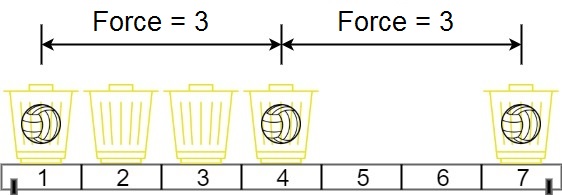
check(k): Given a probable distancek, we can check ifkis feasible by placing balls in order from the leftmost allowed positions while keeping each ball at leastkunits away from the previous one. Ifmballs can be used up before or at the rightmost allowed positions,mballs can have a min distance >=k; Otherwise,kis too large.Lower bound: Obviously, two balls can’t be put together in one single position. The min distance should >= 1.
Upper bound: Suppose all
mballs “distribute” evenly from the leftmost to the rightmost positions, the distance between two adjacent balls is \(\lfloor (P_{n-1} - P_0)/(m-1) \rfloor\). However, probably, not all positions in that “distribution” are allowed \(P_i\) points, so the actual upper bound must <= this value. We add 1 to it just to make sure we have a determined infeasible upper bound as \(\lfloor (P_{n-1} - P_0)/(m-1) \rfloor + 1\).
Now, let’s apply the template:
class Solution:
    def maxDistance(self, position: List[int], m: int) -> int:
        position.sort()
        n = len(position)

        def check(k):
            last = 0
            balls = m-1
            for i in range(1,n):
                if position[i] - position[last]>=k:
                    balls -= 1
                    if balls == 0:
                        return True
                    last = i
            return False

        left, right = 1,(position[-1]-position[0])//(m-1)+1
        while left < right:
            mid = (left+right)//2
            if check(mid):
                left = mid + 1
            else:
                right = mid
        return left - 1
Min Problem
LC1870 Minimum Speed to Arrive on Time: In this problem, the condition function is very clear:
check(k): check if \(\sum_{i=0}^{n-2}{\lceil dist_i/k \rceil} + dist_{n-1}/k \le hour\) holds for a givenk.
The most challenging component of this problem is to determine the corner case in which no feasible speed works. First, except for the last one, all dist[i] must take at least one hour to finish, so it is impossible to commute in time <= n-1 hour. Then, look at the last one, if we increase the speed to some value approaching \(+\infty\), the remaining time cost will also be \(\to 0\). So we just need to check if hour<=n-1, and by the way, we also get a upper bound:
If the bottleneck is due to some largest
dist[i]withini<n-1, as the min time to finish it is 1 hour, the speed,dist[i]hour is sufficient for the situation.If the bottleneck is caused by the last trip,
dist[-1], the time limit may be tighter because the time limit for the last trip could be a float < 1 ashour-(n-1). Hence, the upper bound can be written as \(\lceil \max(dist)/\min(1,hour-n+1) \rceil\), which is definitely safe speed for the problem.
Note
Also, compared to the template, the condition function check(speed) is nagetated but returned bool values are consistent with the problem description, thus, the two branches used to update the range are swapped here. If you’re still not fimilar with the usage, you can simply use if not check(speed) and keep everything else unchanged from the template.
import math
class Solution:
    def minSpeedOnTime(self, dist: List[int], hour: float) -> int:
        def check(speed):
            return sum([(i+speed-1)//speed for i in dist[:-1]]) + dist[-1]/speed <= hour

        n = len(dist)

        if hour <= n-1:
            return -1

        l,r = 1, int(math.ceil(max(dist)/min(1,hour-n+1)))
        while l<r:
            m = (l+r)//2
            if check(m):
                r = m
            else:
                l = m + 1
        return r
More
Some other LC prblems applicable for this template (left as exercises):
Read More
See [1]
Discrete vs. Continuous Binary Search
If the problem is continuous (i.e., the candidate result values are real numbers), you can still use binary search to solve it. Because of IEEE 754, floating-point numbers have limited precision, a coding problem with continous domain usually only requires an approximate result within some error range \(\epsilon\) (EPSILON in code). In this case, you can modify the while loop condition to while right - left > EPSILON: and return left or (left+right)/2 as the final result. The rest of the template remains unchanged.
For example, LC3453 Separate Squares I requires us to find a line parallel to x-axis separating all square areas. Here we need two parts:
Discrete part: check all y=y_i and y=y_i + l_i as candidate separating lines, if there is a minimal y that can separate all squares, return it. If there are two adjacent y1 and y2 values that one make area_upper > area_lower while the other makes area_upper < area_lower, we will find a separating line in the interval (y1,y2).
Continuous part: use binary search to find a y in (y1,y2) such that the difference between area_upper and area_lower is within EPSILON.
EPSILON = 1e-6
class Solution:
    def separateSquares(self, squares: List[List[int]]) -> float:
        sqs = [(y, l) for x,y,l in squares]
        cands = sorted(set([y for y,l in sqs] + [y+l for y,l in sqs]))

        def check(x):
            upper = lower = 0
            for y, l in sqs:
                upper += min(l, max(0, y + l - x)) * l
                lower += min(l, max(0, x - y)) * l
            return upper, lower

        last_neg = None
        left, right = 0, len(cands) - 1
        while left < right:
            mid = (left + right) // 2
            upper, lower = check(cands[mid])
            if lower < upper:
                # last_neg = mid
                left = mid + 1
            else:
                right = mid

        last_neg = left - 1
        upper, lower = check(cands[last_neg])
        if abs(upper - lower) < EPSILON:
            return cands[last_neg]

        left, right = cands[last_neg], cands[last_neg + 1]
        while right - left > EPSILON:
            mid = (left + right) / 2
            upper, lower = check(mid)
            if lower < upper:
                left = mid
            else:
                right = mid
        return (left + right) / 2
Challenge: Median Sort (Google Code Jam Qual 2021 Q4) *
TODO Advanced
https://codingcompetitions.withgoogle.com/codejam/round/000000000043580a/00000000006d1284